The Pediatric Surgery Department has mastered a new method in the treatment of patent processus vaginalis in children.

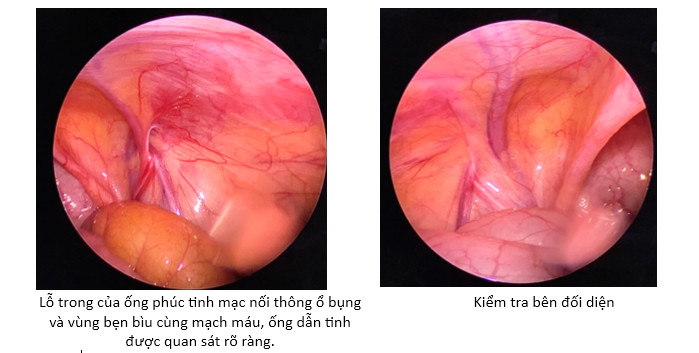
Hai Phong International Obstetrics and Pediatrics Hospital has mastered laparoscopic techniques and successfully performed laparoscopic surgery to treat conditions related to the persistent processus vaginalis (inguinal hernia, hydrocele, spermatic cord cyst) instead of open surgery as before.
What are the common symptoms of inguinal hernia?
- A bulge appears in the groin area (boys) or the groin and labia majora (girls).
- The bulge in the groin or labia majora enlarges when the child coughs, cries, strains, or after vigorous activity; it may reduce when the child rests, lies still, or sleeps.
- The hernia may be painful, causing the child to be fussy, but it can also be painless.
How is inguinal hernia treated?
Usually, when parents see their child crying, they rarely think of inguinal hernia. It is only when the hernia protrudes and cannot retract on its own and becomes strangulated, causing the child to cry out in pain, that the family takes the child to the hospital. At that point, it is very likely that the intestine or ovary has become necrotic. Therefore, the child should undergo surgery to close the processus vaginalis as early as 6 months old after a definitive diagnosis to avoid unfortunate complications.
Surgery is the only treatment method for the condition of patent processus vaginalis (inguinal hernia, hydrocele, spermatic cord cyst). Children need to be operated on early to avoid unfortunate cases leading to strangulation complications and even the need to remove the necrotic herniated organ. With the remarkable development of laparoscopic surgery in pediatric surgery, Hai Phong International Obstetrics and Pediatrics Hospital has mastered laparoscopic techniques and successfully performed laparoscopic surgery to treat the condition of patent processus vaginalis instead of open surgery as before.
In particular, the results of laparoscopic surgery show superiority in aesthetics – scarless surgery (no scar operation) – compared to open surgery, reducing serious and severe complications as documented in the medical literature.report on open surgery: accidental bladder resection, intestinal injury, vascular injury… during the process of open dissection. On the other hand, laparoscopic surgery helps reduce the risk of operating on the wrong side, and especially helps detect early and treat simultaneously cases of bilateral inguinal hernias; preventing the situation where children have to be hospitalized multiple times, thereby reducing the financial burden of treatment for the patient’s family.